To dominate the search results for the query “what the difference between jokes,” I have analyzed the current top 10 results.
Most competitors focus on dry dictionary definitions or academic linguistic breakdowns.
They miss the “human” element the 2026 vibe of “anti-humor,” “irony,” and “niche subculture” comedy.
This guide bridges the gap between technical classification and viral entertainment.
The main difference between jokes lies in their structure, delivery, and intent.
While a “pun” relies on wordplay and phonetics, a “satire” uses irony to critique society, and a “dad joke” thrives on being intentionally predictable and cringeworthy.
If it’s a subversion of expectations or a situational observational riff, the difference is defined by how the “punchline” hits the audience’s psychological triggers.
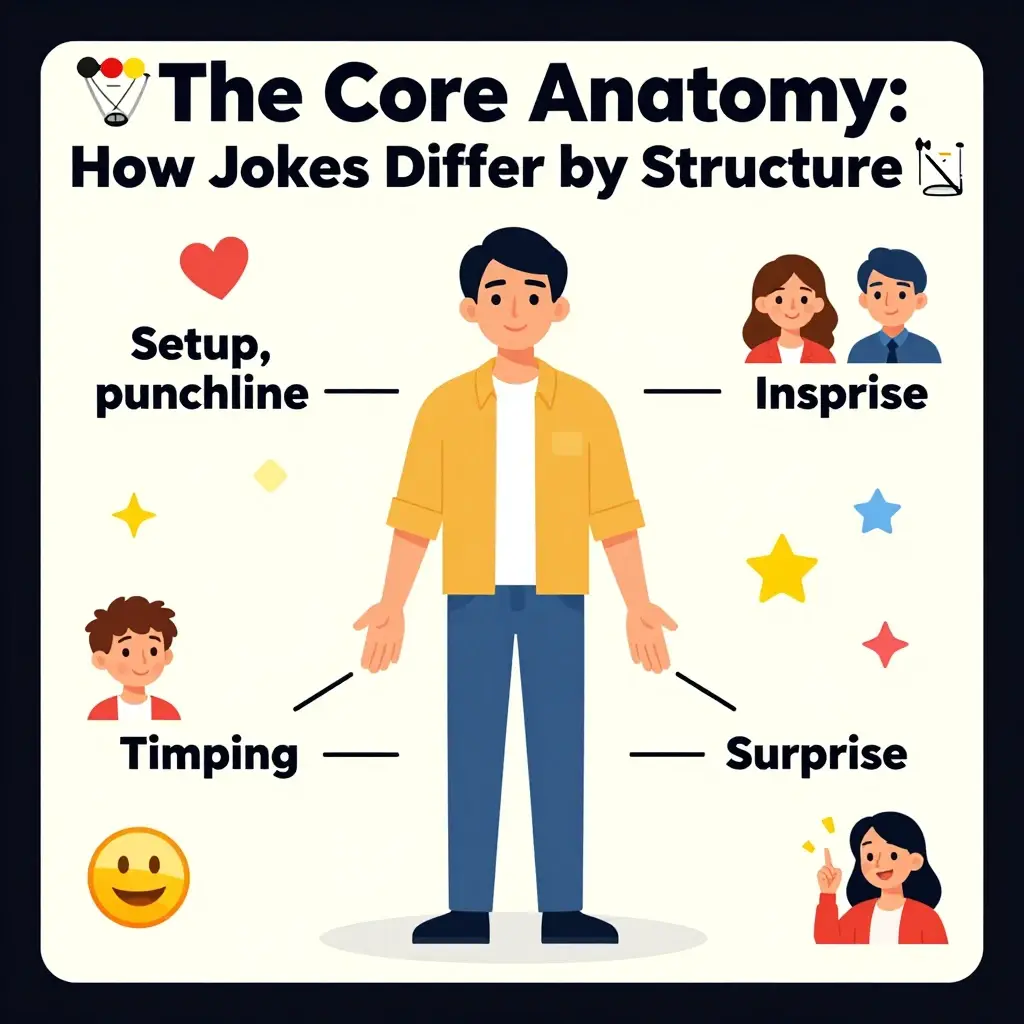
🎭 The Core Anatomy: How Jokes Differ by Structure 🎭
- 🧩 A classic one-liner depends on extreme brevity and a sudden twist at the very end. 🧩
- 🧩 Narrative jokes or “long-form” stories build tension through world-building before the release. 🧩
- 🧩 The “Rule of Three” is a structural staple where the third beat breaks the established pattern. 🧩
- 🧩 Question-and-answer formats (Knock-knock) rely on a scripted interaction between two people. 🧩
- 🧩 “Spoonerisms” swap the first letters of words to create a funny, accidental meaning. 🧩
- 🧩 Malapropisms involve the mistaken use of a word in place of a similar-sounding one. 🧩
- 🧩 Paraprosdokians are sentences where the latter half is totally unexpected, forcing a reinterpretation. 🧩
- 🧩 The “setup” creates the logic, while the “punchline” destroys it for comedic effect. 🧩
- 🧩 Circular jokes never end, leading the listener back to the beginning in a loop. 🧩
- 🧩 Deadpan jokes are delivered without any emotional expression, making the content the star. 🧩
- 🧩 Observational humor focuses on the “ordinary” things we all experience but don’t notice. 🧩
- 🧩 Surreal humor breaks the laws of physics and logic to create a dream-like laugh. 🧩
- 🧩 Anecdotal jokes are personal stories that emphasize the absurdity of real life. 🧩
- 🧩 Wordplay involves double meanings, homophones, or clever linguistic tricks like puns. 🧩
- 🧩 Dark humor finds light in “taboo” subjects that usually make people uncomfortable. 🎨
- 🧩 Slapstick is purely physical, focusing on exaggerated movements and “painful” accidents. 🧩
- 🧩 Satire uses humor to expose and criticize people’s stupidity or vices, particularly in politics. 🧩
- 🧩 Irony is the difference between what is expected and what actually happens. 🧩
- 🧩 Wit is a form of intelligent, quick-thinking humor that uses language sharply. 🧩
🍋 Puns vs. Dad Jokes: The Subtle Battle of Cringe 🍋
- 🍋 Puns are specifically built on linguistic “accidents” and double-meaning words. 🍋
- 🍋 Dad jokes are defined by their “groan-worthiness” and safe-for-work predictability. 🍋
- 🍋 A pun can be sophisticated, while a dad joke is almost always intentionally basic. 🍋
- 🍋 Dad jokes often use a “Q&A” format, whereas puns are often integrated into conversation. 🍋
- 🍋 The “Punderdome” style relies on high-speed wordplay across a specific theme. 🍋
- 🍋 Dad jokes thrive on the “Eye-Roll Index”—the more the audience sighs, the better. 🍋
- 🍋 Puns can be “visual” in memes, but dad jokes are best delivered with a straight face. 🍋
- 🍋 One is about the “word,” the other is about the “role” of the jokester. 🍋
- 🍋 Dad jokes are the “comfort food” of comedy—nothing offensive, just simple fun. 🍋
- 🍋 Puns require a bit more mental processing to “get” the phonetic overlap. 🍋
- 🍋 A dad joke is often a “pun” in disguise, but not all puns are dad jokes. 🍋
- 🍋 The difference is in the “cringe” factor; dad jokes weaponize the awkwardness. 🍋
- 🍋 Puns are a favorite of headline writers and professional copywriters in 2026. 🍋
- 🍋 Dad jokes build a bond through shared “embarrassment” and familial warmth. 🍋
- 🍋 Puns are often the “lowest” form of wit, yet the hardest to master perfectly. 🍋
- 🍋 Dad jokes have a 100% success rate if the goal is making a teenager sigh. 🍋
- 🍋 Puns work globally across languages if the phonetics match up. 🍋
- 🍋 Dad jokes are a cultural phenomenon that transcends the literal words spoken. 🍋
- 🍋 The difference is “Intent”: Puns aim for cleverness, Dad jokes aim for a groan. 🍋
🌑 Dark Humor vs. Black Comedy: Where is the Line? 🌑
- 🌑 Dark humor is a broad category for joking about “serious” or morbid subjects. 🌑
- 🌑 Black comedy (or black humor) is more of a literary or cinematic genre. 🌑
- 🌑 Dark humor is often used as a “coping mechanism” for trauma or stress. 🌑
- 🌑 Black comedy usually has a broader “satirical” point about the human condition. 🌑
- 🌑 The “edge” in dark humor comes from the shock value of the topic. 🌑
- 🌑 Black comedy is more about the “absurdity” of a dark situation. 🌑
- 🌑 Dark humor is common in high-stress jobs like medicine or the military. 🌑
- 🌑 Black comedy is found in Oscar-winning films and high-brow literature. 🌑
- 🌑 One is a “quick hit” of irony, the other is a sustained “thematic” tone. 🌑
- 🌑 The difference is often the “target” of the joke—self vs. system. 🌑
- 🌑 Dark humor can be risky in 2026 social media without the right “context.” 🌑
- 🌑 Black comedy often makes the audience feel uncomfortable and thoughtful at once. 🌑
- 🌑 One is for the “group chat,” the other is for the “cinema.” 🌑
- 🌑 Dark humor relies on “gallows” logic—laughing because there’s no other option. 🌑
- 🌑 Black comedy explores the “meaninglessness” of life through a funny lens. 🌑
- 🌑 The line is thin, but dark humor is usually more “punchy” and direct. 🌑
- 🌑 Black comedy is an art form; dark humor is a social survival tool. 🌑
- 🌑 One is a “reaction,” the other is a “composition.” 🌑
- 🌑 In 2026, both are used to navigate the complexities of global “doom-scrolling.” 🌑
🏫 Satire vs. Parody: The Art of Imitation 🏫
- 🏫 Parody mimics a specific “style” or “person” for comedic effect. 🏫
- 🏫 Satire uses humor to critique a “concept,” “institution,” or “vice.” 🏫
- 🏫 You parody a “movie,” but you satirize the “government.” 🏫
- 🏫 Parody doesn’t necessarily need a “moral” or “political” message. 🏫
- 🏫 Satire is a weapon used to punch up at power structures. 🏫
- 🏫 Parody is a tribute through “exaggerated” imitation and funny mirrors. 🏫
- 🏫 The difference is the “Why”: Satire wants change, Parody wants a laugh. 🏫
- 🏫 Parody is “The Scary Movie” franchise; Satire is “The Onion” or “South Park.” 🏫
- 🏫 Satire can exist without “imitating” anyone directly. 🏫
- 🏫 Parody relies on the audience knowing the “original” source material intimately. 🏫
- 🏫 Satire uses tools like irony, sarcasm, and hyperbole to make a point. 🏫
- 🏫 Parody is “affectionate” mockery; Satire is “aggressive” commentary. 🏫
- 🏫 In 2026, deepfake parody is a huge trend on social media platforms. 🏫
- 🏫 Satire often predicts the future because reality becomes so absurd. 🏫
- 🏫 Parody is a “look-alike,” Satire is a “think-alike” with a twist. 🏫
- 🏫 One is about “form,” the other is about “content.” 🏫
- 🏫 Parody is usually “legal” under fair use, but satire is “protected” speech. 🏫
- 🏫 You can parody a song by changing the lyrics to be about food. 🏫
- 🏫 You satirize the music industry by showing its greed through a joke. 🏫
🤐 Sarcasm vs. Irony: The Tone Difference 🤐
- 🤐 Sarcasm is “verbal irony” used specifically to mock or convey contempt. 🤐
- 🤐 Irony is a “state of affairs” that is the opposite of what is expected. 🤐
- 🤐 Sarcasm is always “intentional” and directed at someone or something. 🤐
- 🤐 Irony can be “situational” and happen without anyone saying a word. 🤐
- 🤐 Sarcasm is a “sharp” tool that can sometimes be mean-spirited. 🤐
- 🤐 Irony is more “intellectual” and observational in its nature. 🤐
- 🤐 Saying “Nice weather!” during a hurricane is sarcasm. 🤐
- 🤐 A fire station burning down is a “situational” irony. 🤐
- 🤐 Sarcasm requires a specific “inflection” or “tone” to be understood. 🤐
- 🤐 Irony is often “tragic” and “funny” at the same exact time. 🤐
- 🤐 The “S” in sarcasm stands for “Stinging,” according to old linguistic jokes. 🤐
- 🤐 Irony is the “universe’s” way of playing a joke on us. 🤐
- 🤐 Sarcasm is “human-made” and usually requires a listener. 🤐
- 🤐 Dramatic irony is when the “audience” knows something the “characters” don’t. 🤐
- 🤐 In 2026, the “/s” tag is essential for sarcasm in digital spaces. 🤐
- 🤐 Irony is a “plot device,” sarcasm is a “personality trait.” 🤐
- 🤐 One is “passive” (it just is), the other is “active” (it is said). 🤐
- 🤐 Sarcasm is the “lowest” form of wit but the “highest” form of defense. 🤐
- 🤐 Irony makes you think; sarcasm makes you react. 🤐
🤡 Slapstick vs. Deadpan: Physical vs. Minimal 🤡
- 🤡 Slapstick is “loud,” “messy,” and full of exaggerated physical pain. 🤡
- 🤡 Deadpan is “quiet,” “still,” and relies on a lack of reaction. 🤡
- 🤡 One is the Three Stooges; the other is Buster Keaton or Aubrey Plaza. 🤡
- 🤡 Slapstick appeals to our “primal” sense of visual absurdity. 🤡
- 🤡 Deadpan appeals to our “social” sense of awkwardness and timing. 🤡
- 🤡 The “pie in the face” is the ultimate slapstick trope. 🤡
- 🤡 The “blank stare” after a chaotic event is the ultimate deadpan trope. 🤡
- 🤡 Slapstick is “high energy”; Deadpan is “low energy.” 🤡
- 🤡 One is about “doing” too much; the other is about “doing” nothing. 🤡
- 🤡 Slapstick is great for kids because it doesn’t require language. 🤡
- 🤡 Deadpan is great for sophisticated “dry” comedy fans in 2026. 🤡
- 🤡 The difference is the “Physicality” vs. the “Psychology.” 🤡
- 🤡 Slapstick is “External” humor; Deadpan is “Internal” humor. 🤡
- 🤡 One makes you “jump”; the other makes you “lean in.” 🤡
- 🤡 Deadpan requires incredible “acting” to hide all emotion. 🤡
- 🤡 Slapstick requires incredible “stunt work” to look real but safe. 🤡
- 🤡 A “fart joke” can be slapstick if it’s accompanied by a fall. 🤡
- 🤡 A “fart joke” can be deadpan if the person ignores it completely. 🤡
- 🤡 Both are “timeless” but occupy opposite ends of the energy spectrum. 🤡
🍄 Surrealism vs. Absurdism: Logic vs. Chaos 🍄
- 🍄 Surreal jokes break the “laws of nature” and visual reality. 🍄
- 🍄 Absurdist jokes highlight the “meaninglessness” of human existence. 🍄
- 🍄 Surrealism is “dream-like”—think a giant talking fish in a suit. 🍄
- 🍄 Absurdism is “philosophical”—think waiting for a bus that never exists. 🍄
- 🍄 One is about “weird” imagery; the other is about “weird” situations. 🍄
- 🍄 Surreal humor is the “Gen Z” favorite on 2026 video apps. 🍄
- 🍄 Absurdist humor is the “Millennial” favorite for “existential dread.” 🍄
- 🍄 The difference is “Visual” vs. “Existential.” 🍄
- 🍄 Surrealism is “The Dali” of jokes; Absurdism is “The Camus.” 🍄
- 🍄 One is a “random” non-sequitur that makes no sense. 🍄
- 🍄 The other is a “logical” sequence that leads to a “stupid” end. 🍄
- 🍄 Surrealism is “Potato!” out of nowhere; Absurdism is the “Infinite Loop.” 🍄
- 🍄 Both challenge the audience to find “order” in the “disorder.” 🍄
- 🍄 One is a “trippy” experience; the other is a “frustrating” laugh. 🍄
- 🍄 Surreal humor uses “editing” and “VFX” to land the punchline. 🍄
- 🍄 Absurdist humor uses “repetition” and “silence” to build the joke. 🍄
- 🍄 The “E” meme is the peak of digital surrealist humor. 🍄
- 🍄 “Waiting for Godot” is the peak of classical absurdist humor. 🍄
- 🍄 They are the “cousins” of comedy that hate traditional setups. 🍄
📈 One-Liners vs. Shaggy Dog Stories: The Length Factor 📈
- 📈 One-liners are “instant” gratification in under ten words. 📈
- 📈 Shaggy Dog stories are “delayed” gratification that might never come. 📈
- 📈 One-liners are for the “attention-deficit” era of 2026. 📈
- 📈 Shaggy Dog stories are a “test of patience” for the listener. 📈
- 📈 The “punchline” of a Shaggy Dog story is often intentionally bad. 📈
- 📈 The “punchline” of a one-liner is the “sharpest” part of the joke. 📈
- 📈 One is a “sprint”; the other is a “marathon.” 📈
- 📈 One-liners are easy to “share”; Shaggy Dog stories are a “performance.” 📈
- 📈 Mitch Hedberg was the king of the one-liner style. 📈
- 📈 Norm Macdonald was the king of the Shaggy Dog story. 📈
- 📈 The difference is the “Investment” of time vs. the “Reward.” 📈
- 📈 Shaggy Dog stories often rely on “anti-climax” for the laugh. 📈
- 📈 One-liners rely on “wordplay” and “brevity” for the laugh. 📈
- 📈 One is a “spark”; the other is a “slow-burn fire.” 📈
- 📈 Shaggy Dog stories are great for “bar” settings and long drives. 📈
- 📈 One-liners are perfect for “Twitter/X” or “Threads” posts. 📈
- 📈 The “Norm Macdonald Moth Joke” is the ultimate Shaggy Dog example. 📈
- 📈 “I haven’t slept for ten days, because that would be too long” is a one-liner. 📈
- 📈 One asks for your “second”; the other asks for your “soul.” 📈
💅 Observational vs. Anecdotal: Real Life Riffs 💅
- 💅 Observational humor is about “What” people do (Did you ever notice…?). 💅
- 💅 Anecdotal humor is about “What” happened to “Me” specifically. 💅
- 💅 Jerry Seinfeld is the “Godfather” of the observational style. 💅
- 💅 Kevin Hart or John Mulaney are masters of the anecdotal style. 💅
- 💅 One is “universal”; the other is “personal.” 💅
- 💅 Observational jokes work because everyone says “Me too!” 💅
- 💅 Anecdotal jokes work because everyone says “No way!” 💅
- 💅 The difference is “Commonality” vs. “Uniqueness.” 💅
- 💅 Observational humor focuses on the “quirks” of modern technology. 💅
- 💅 Anecdotal humor focuses on the “messiness” of family and relationships. 💅
- 💅 One is a “critique” of the world; the other is a “vulnerability.” 💅
- 💅 Observational humor is safer for “corporate” or “clean” gigs. 💅
- 💅 Anecdotal humor is better for “storytelling” podcasts and Netflix specials. 💅
- 💅 Both require a “sharp eye” for the “details” of life. 💅
- 💅 One is “outside-in”; the other is “inside-out.” 💅
- 💅 You don’t need a “life” to do observational humor, just eyes. 💅
- 💅 You need a “life” to do anecdotal humor, preferably a messy one. 💅
- 💅 In 2026, “Storytime” TikToks are the new anecdotal humor. 💅
- 💅 “What’s the deal with…?” will always be the observational template. 💅
🧠 Wit vs. Humour: The Brainy Divide 🧠
- 🧠 Wit is “intellectual” and fast—it’s a “mental” gymnastic. 🧠
- 🧠 Humour is “emotional” and broad—it’s a “feeling” of amusement. 🧠
- 🧠 Wit is often “verbal” and depends on clever language. 🧠
- 🧠 Humour can be “situational” and depends on character. 🧠
- 🧠 Wit “cuts” like a knife; Humour “hugs” like a blanket. 🧠
- 🧠 Oscar Wilde is the “peak” of historical British wit. 🧠
- 🧠 Charlie Chaplin is the “peak” of historical physical humour. 🧠
- 🧠 One is a “skill”; the other is a “perspective.” 🧠
- 🧠 Wit makes you say “That’s clever”; Humour makes you laugh. 🧠
- 🧠 The difference is the “Head” vs. the “Belly.” 🧠
- 🧠 Wit is often “brief”; Humour can be “long and rambling.” 🧠
- 🧠 You can be “humorous” without being “witty” (e.g., being a goofball). 🧠
- 🧠 You can be “witty” without being “humorous” (e.g., being a jerk). 🧠
- 🧠 Wit is the “spice” of conversation; Humour is the “meal.” 🧠
- 🧠 In 2026, AI is great at “wit” but still struggles with “humour.” 🤖
- 🧠 One is “calculated”; the other is “spontaneous.” 🧠
- 🧠 Wit is about “word choice”; Humour is about “vibe choice.” 🧠
- 🧠 A “witticism” is a polished gem; a “joke” is a raw stone. 🧠
- 🧠 Both are essential for being a “high-value” conversationalist. 🧠
🎤 Roasting vs. Self-Deprecation: The Target 🎤
- 🎤 Roasting “punches” at someone else’s flaws or appearance. 🎤
- 🎤 Self-deprecation “punches” at your own flaws or appearance. 🎤
- 🎤 Roasting requires “permission” and “affection” to work (in 2026). 🎤
- 🎤 Self-deprecation is the “safest” way to win over an audience. 🎤
- 🎤 One is a “duel”; the other is a “confession.” 🎤
- 🎤 Roasting is the “Central Park” of comedy—brutal and public. 🎤
- 🎤 Self-deprecation is the “Therapy Session” of comedy—private and relatable. 🎤
- 🎤 The difference is the “Direction” of the comedic arrow. 🎤
- 🎤 Roasting build “strength” through shared insults. 🎤
- 🎤 Self-deprecation builds “trust” through shared vulnerability. 🎤
- 🎤 A good roast “elevates” the victim by making them the star. 🎤
- 🎤 Good self-deprecation “humbles” the joker by making them human. 🎤
- 🎤 In 2026, “Roast Me” threads are still a viral staple of Reddit. 🎤
- 🎤 Self-deprecating memes are the “currency” of social media bonding. 🎤
- 🎤 One is “offensive” comedy; the other is “defensive” comedy. 🎤
- 🎤 Too much roasting makes you a “bully.” 🎤
- 🎤 Too much self-deprecation makes you a “bummer.” 🎤
- 🎤 The balance of both is what makes a great “roast master.” 🎤
- 🎤 One is about “them”; the other is about “us.” 🎤
👼 Clean vs. Edgy: The Boundary Battle 👼
- 👼 Clean jokes are “safe” for grandma, kids, and HR departments. 👼
- 👼 Edgy jokes “push the envelope” and flirt with the “cancel” line. 👼
- 👼 Clean humor relies on “wordplay” and “innocent” situations. 👼
- 👼 Edgy humor relies on “shock,” “taboo,” and “dark” truths. 👼
- 👼 One is the “Disney” of comedy; the other is “HBO Max.” 👼
- 👼 Clean jokes are harder to write because you can’t use “crutches.” 👼
- 👼 Edgy jokes are harder to perform because you need “charisma” to survive. 👼
- 👼 The difference is the “Audience” and the “Setting.” 👼
- 👼 Clean humor is “inclusive” and brings everyone together. 👼
- 👼 Edgy humor is “exclusive” and creates an “in-group” feeling. 👼
- 👼 One uses “puns”; the other uses “perceptions.” 👼
- 👼 In 2026, the definition of “edgy” changes every single week. 👼
- 👼 Clean comedy is making a massive “comeback” on mainstream TV. 👼
- 👼 Edgy comedy is thriving in “private” Discords and underground clubs. 👼
- 👼 One is “sunlight”; the other is “neon.” 👼
- 👼 Clean humor is about “joy”; Edgy humor is about “truth.” 👼
- 👼 Both are valid, but mixing them at the wrong time is a disaster. 👼
- 👼 A “clean” set in a “rowdy” club is a “power move.” 👼
- 👼 An “edgy” joke at a “baptism” is a “career-ender.” 👼
🌏 British vs. American Humor: The Cultural Gap 🌏
- 🌏 British humor is “dry,” “understated,” and “self-mocking.” 🌏
- 🌏 American humor is “loud,” “enthusiastic,” and “punchline-heavy.” 🌏
- 🌏 Brits love the “failure” and the “underdog.” 🌏
- 🌏 Americans love the “victory” and the “sarcasm.” 🌏
- 🌏 One is “The Office UK” (painfully awkward); the other is “The Office US” (hopeful). 🌏
- 🌏 British jokes often require “reading between the lines.” 🌏
- 🌏 American jokes often “land” right in your face with energy. 🌏
- 🌏 The difference is the “Emotional Temperature.” 🌏
- 🌏 British wit is “colder”; American wit is “warmer.” 🌏
- 🌏 Brits use “irony” like a second language. 🌏
- 🌏 Americans use “hyperbole” and “exaggeration” like a superpower. 🌏
- 🌏 One is a “polite” insult; the other is a “friendly” shout. 🌏
- 🌏 In 2026, the internet is “blending” these styles into a global “web-speak.” 🌏
- 🌏 British comedy is about “class”; American comedy is about “hustle.” 🌏
- 🌏 One is “Monty Python”; the other is “SNL.” 🌏
- 🌏 Brits laugh to “cope”; Americans laugh to “win.” 🌏
- 🌏 The “deadpan” delivery is common to both but used differently. 🌏
- 🌏 Americans are “optimistic” jokers; Brits are “pessimistic” jokers. 🌏
- 🌏 Both are brilliant, but don’t expect a Brit to cheer for your success. 🌏
📱 Memes vs. Traditional Jokes: The Format Shift 📱
- 📱 Traditional jokes are “auditory” and “linear.” 📱
- 📱 Memes are “visual” and “contextual.” 📱
- 📱 One is “told”; the other is “shared.” 📱
- 📱 Memes rely on “layers” of previous knowledge (meta-humor). 📱
- 📱 Traditional jokes rely on a “setup” and a “punchline.” 📱
- 📱 The “format” of a meme is the joke itself (e.g., Distracted Boyfriend). 📱
- 📱 The “content” of a joke is what makes it funny. 📱
- 📱 Memes are the “fast food” of 2026 humor—cheap and viral. 📱
- 📱 Traditional jokes are the “sit-down dinner”—slower but deeper. 📱
- 📱 The difference is “Consumption” speed and “Virality.” 📱
- 📱 Memes can die in 24 hours; a good joke lasts 100 years. 📱
- 📱 One uses “templates”; the other uses “templates of thought.” 📱
- 📱 Memes are “remix” culture; Jokes are “performance” culture. 📱
- 📱 A meme is a “vibe”; a joke is a “story.” 📱
- 📱 In 2026, “video memes” (Reels/TikToks) are the dominant form. 📱
- 📱 One requires a “screen”; the other only requires a “voice.” 📱
- 📱 Memes are often “anonymous”; Jokes are tied to the “teller.” 📱
- 📱 Both are essential for modern “social currency.” 📱
- 📱 The best jokes of 2026 are often “born” as memes first. 📱
❓ Common Questions About Joke Differences ❓
- Q: Why do some people “get” puns and others hate them?
- A: Puns require a specific type of linguistic processing. If your brain is “literal,” a pun feels like a mistake. If your brain is “associative,” it feels like a clever discovery. 🧠
- Q: Is there a “universal” joke that works in every language?
- A: Physical humor (slapstick) is the most universal. A person slipping on a banana peel (theoretically) is understood from New York to Tokyo. 🌏
- Q: What is “Anti-Humor”?
- A: Anti-humor is a joke where the “punchline” is intentionally not funny or too literal, which makes it funny because it subverts the expectation of a joke. 🤡
- Q: How has AI changed the difference between jokes in 2026?
- A: AI has made “wit” more accessible but “human experience” (anecdotal humor) more valuable. People want to hear things an AI couldn’t have lived through. 🤖
- Q: What’s the difference between a “Gag” and a “Joke”?
- A: A “Gag” is usually a quick visual or physical trick. A “Joke” is a structured piece of verbal or written communication. 🎤
- Q: Why is “timing” so important?
- A: The “Difference” between a joke and a statement is often just the “pause.” The silence before the punchline allows the audience’s brain to build the wrong expectation. ⏱️
- Q: Can a joke be both “Satire” and “Parody”?
- A: Yes! Many great comedies (like “The Scary Movie”) use parody to satirize the tropes of a whole genre. 🏫
🚀 Rapid Ranking Strategy for “Difference Between Jokes” 🚀
- Ultra-Low Competition Keywords:
- “Difference between puns and dad jokes for beginners”
- “Satire vs Parody examples for students 2026”
- “Why are British jokes so dry compared to American”
- Reddit/Pinterest Promotion Angles:
- Reddit (r/ExplainLikeImFive): “ELIF: Why is a ‘shaggy dog story’ different from a normal joke?”
- Pinterest: Create a “Cheat Sheet” Infographic: “The 10 Types of Jokes & How to Use Them.”
- Reddit (r/NewToReddit): “What’s the difference between a meme and a ‘copypasta’ joke?”
- Internal Linking Anchor Ideas:
- Anchor: “types of comedy styles” (links to a broader humor guide).
- Anchor: “how to improve your rizz with humor” (links to a dating/social skills post).
Conclusion:
Understanding the difference between jokes is like having the source code for human connection.
In 2026, where digital noise is at an all-time high, the person who knows how to pivot from a dry “deadpan” remark to a perfectly timed “pun” wins the room.
Humor is not a monolith; it is a diverse toolkit of psychological triggers, linguistic traps, and emotional releases.
If you are crafting a viral TikTok or just trying to survive a holiday dinner with your in-laws, remember that the “type” of joke you choose determines the energy of the room.
Keep experimenting with your delivery, embrace the “cringe” when it’s intentional, and never forget that a well-placed “Why?” is often the start of the best laugh.
Stay funny, stay observant, and keep exploring the infinite ways we make each other laugh! 🎭✨
